The predicament of traditional open source funding models stems from multiple factors. First, the severe inequality in fund distribution leads to many excellent GitHub projects failing to receive the support they deserve. Second, individual investors find it difficult to gain direct benefits from open source funding, which often limits funding sources to influential figures in the industry or large corporate organizations. More critically, the funding received by project maintainers is usually insufficient to cover long-term maintenance costs, seriously dampening developers' enthusiasm. In this situation, we can't help but ask: isn't there a win-win solution to solve this problem?
Gitrant's innovation lies in its clever tokenization of open source projects and putting them on-chain, achieving a perfect combination of open source projects and financial markets. On the Gitrant platform, each open source project corresponds to an independent token pool, using a Bonding Curve algorithm to dynamically control prices. Users can support open source projects they favor by purchasing project Shares, and the price of Shares increases as the supply increases. This mechanism not only provides a continuous source of funding for projects but also creates potential profit opportunities for investors.
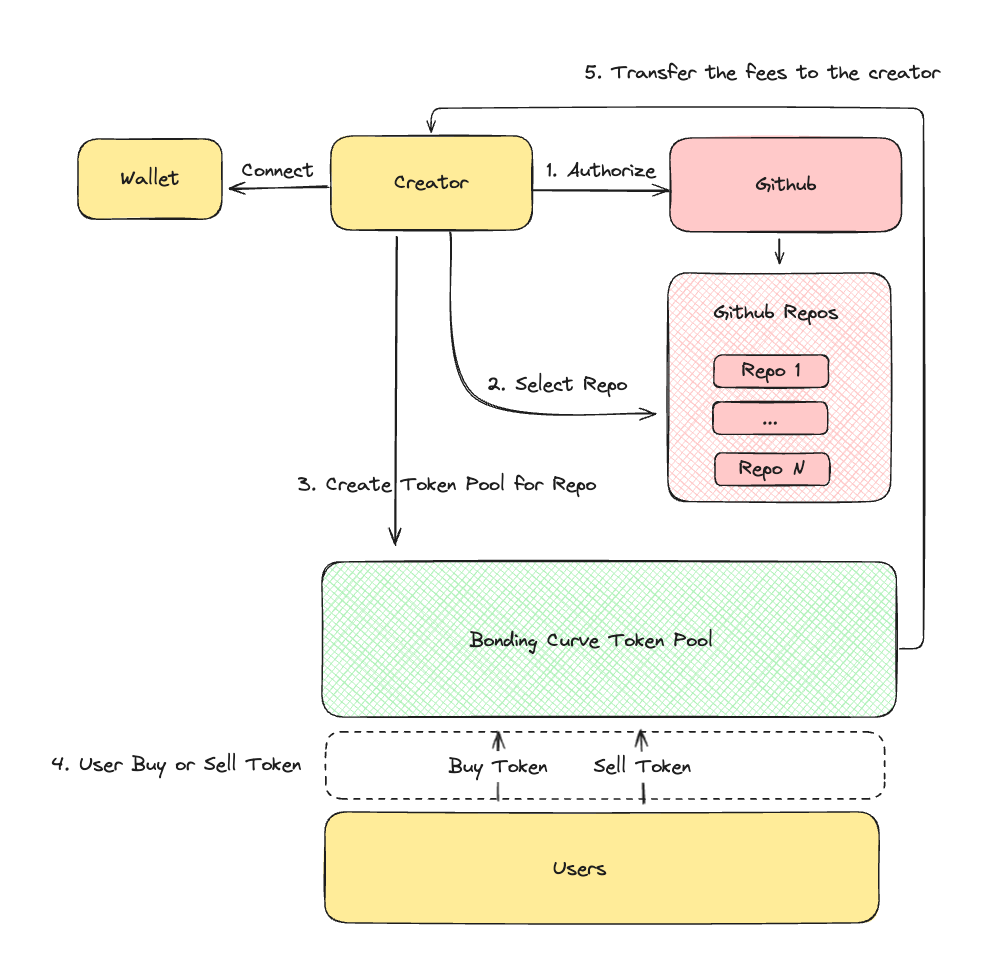
In Gitrant's ecosystem, the roles of project maintainers and investors have undergone qualitative changes. For maintainers, the process of tokenizing GitHub projects has become exceptionally simple, requiring only a Solana wallet and a small Gas fee. They can earn continuous income by charging fixed fees in market transactions. More importantly, this mechanism incentivizes maintainers to continuously improve and optimize their projects, as the quality of the project directly affects the market's trading enthusiasm for its Shares.
Investors transform from mere donors to market participants. They search for potential open source projects on the platform and gain potential returns by trading Shares. This market-oriented selection mechanism ensures that funds naturally flow to truly excellent projects, forming a virtuous cycle. Whether investors are motivated by pure support or investment purposes, their actions are promoting the healthy development of the open source ecosystem.
Gitrant's influence extends far beyond this. Against the backdrop of over 30 million programmers worldwide, open source projects have always been one of the most valuable assets in the internet world. Gitrant not only provides new opportunities for this vast innovative community but also establishes a value assessment system for open source projects, promoting the optimization of resource allocation. It ingeniously combines the open source spirit with market mechanisms, paving a new path for sustainable development in the open source world.
Looking to the future, we have reason to believe that Gitrant will become a key force in promoting the prosperity of the open source ecosystem. It is not just a funding platform, but a bridge connecting open source contributors and supporters. Through Gitrant, every line of code has the potential to receive due recognition and reward, and every excellent idea can find soil for realization. With Gitrant's support, the open source world will usher in unprecedented vitality and innovation, injecting continuous momentum into technological development.
Fee Distribution Mechanism
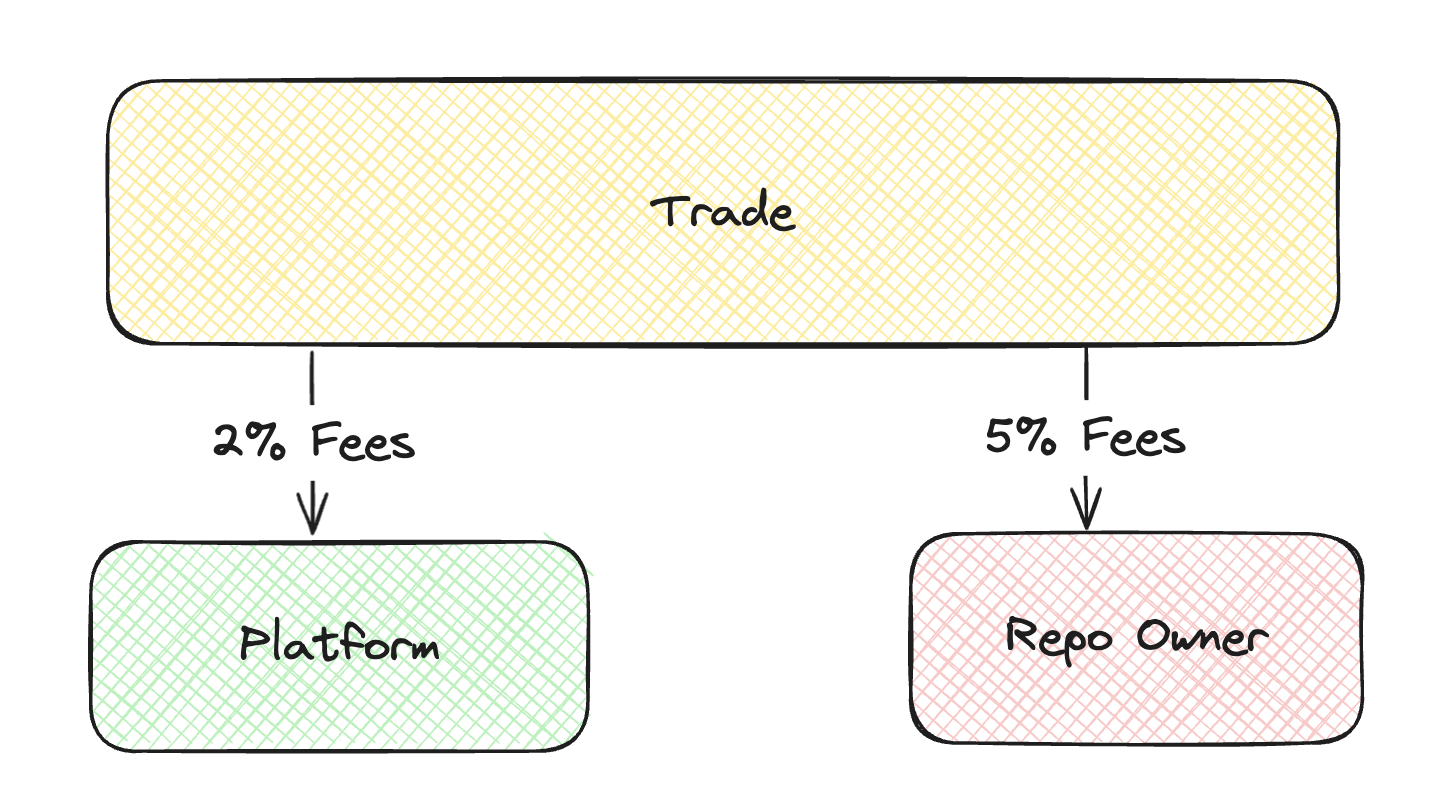
Gitrant platform adopts an innovative fee distribution model aimed at incentivizing the continuous development and contribution of open source projects. For each share transaction, the platform charges two types of fees: platform operation fee (2%) and repository owner fee (5%), though these parameters may be adjusted when launching on the mainnet.
Platform fees support daily operations and continuous improvements, while repository owner fees directly incentivize project maintainers. For example, in a $100 transaction, $2 goes to the platform, and $5 is directly allocated to the repository owner.
More forward-looking is Gitrant's planned fee redistribution feature, a key mechanism for promoting open source ecosystem collaboration. Repository owners can flexibly distribute their fee income to core contributors, maintainers of dependent projects, and others, thereby building a more mutually beneficial open source collaboration ecosystem.
For example, when a repository owner receives $100 in fees, they can distribute it as follows:
- $10 to core contributor A
- $10 to core contributor B
- $20 to core library owner C
It's worth noting that there are two ways to distribute the fees to the core libraries: (1) If the repository has already been tokenized, the amount allocated to the repository will be automatically used to purchase the repository's token, and the repository's token will be burned, which helps maintain the stability of the repository's token. (2) If the repository is not tokenized, the fees can be distributed directly to the address provided by the repository owner in the normal way.
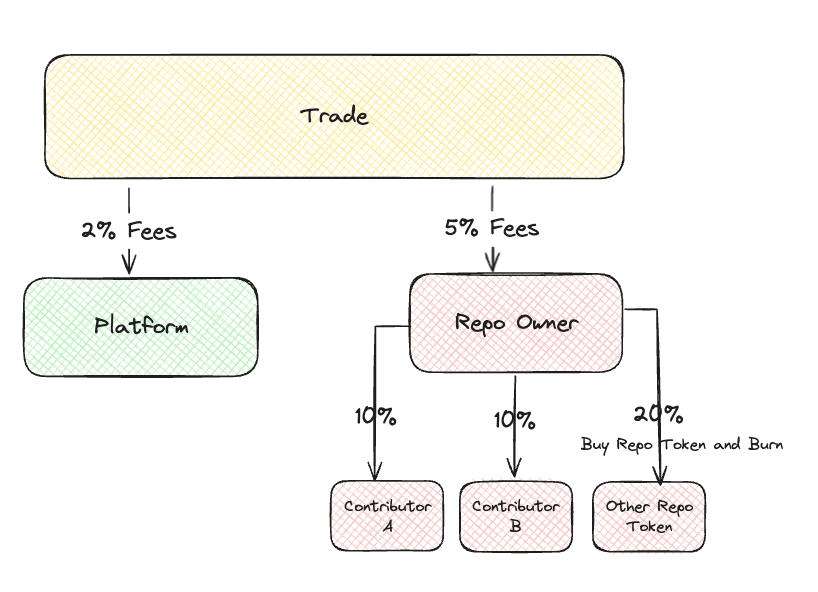
(1) Use the fee to buy repository token and burn
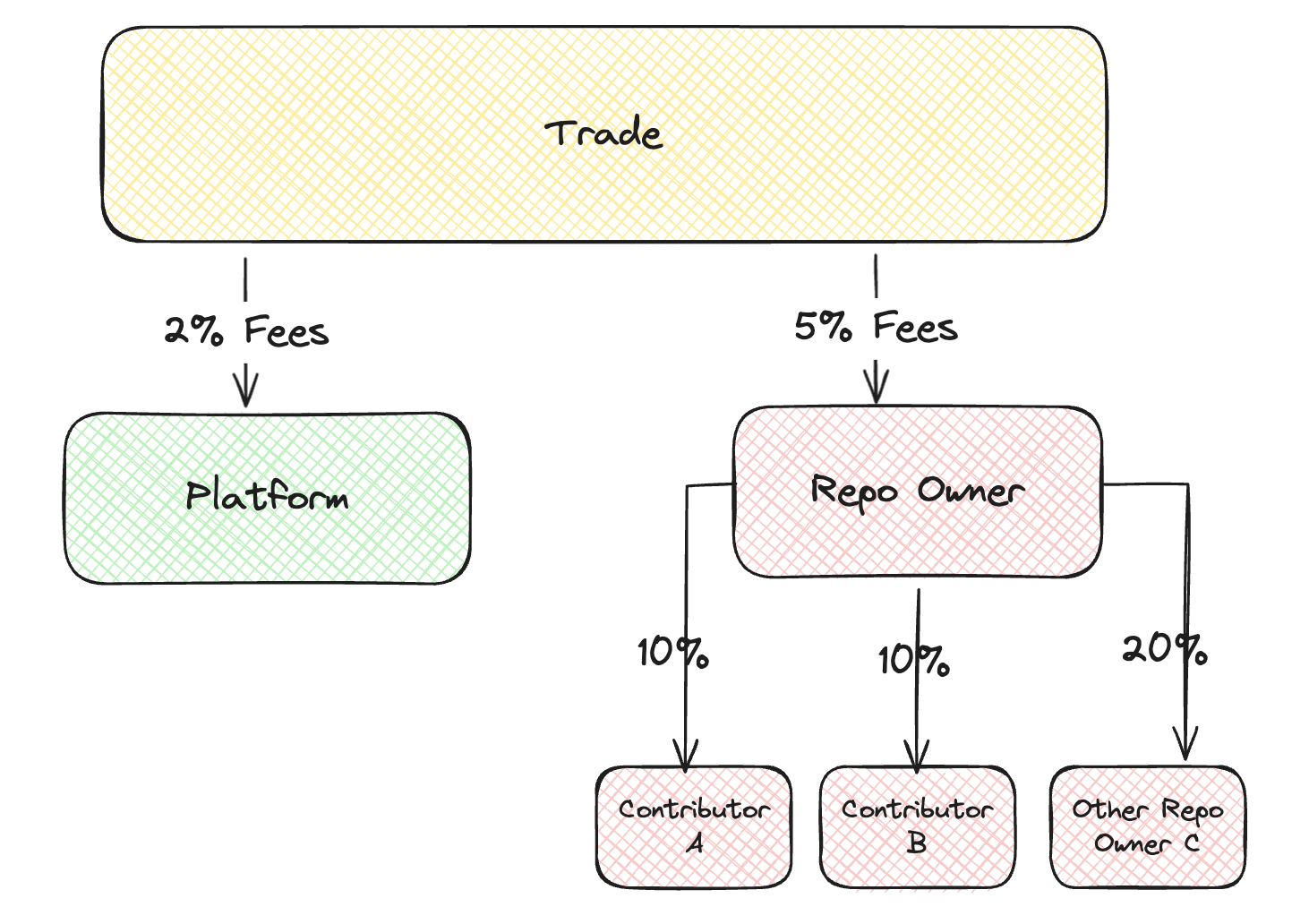
(2) Distribute the fee to the owner of the repository
In addition, if a repository B is forked from a repository A, and if repository A has already deployed a token, then half of the fees of repository B will be automatically allocated to repository A to purchase repository A's token and burn it.
This redistribution is fully automated within smart contracts. Once owners set up distribution addresses and ratios, subsequent fee income is automatically distributed according to preset rules without manual intervention. This not only simplifies the fund distribution process but, more importantly, establishes a sustainable and mutually beneficial economic incentive model for open source projects.
Through this mechanism, Gitrant is not just a funding platform but an ecosystem builder capable of activating open source innovation vitality.
AI-Powered Investment Analysis
Gitrant introduces revolutionary AI-powered investment analysis tools that transform how investors evaluate open source projects. Our advanced AI chat system provides intelligent, data-driven insights to help users make informed investment decisions.
Key AI Features
Intelligent Repository Analysis
- Comprehensive project evaluation using GitHub data
- Real-time development activity assessment
- Community health and contributor analysis
- Technology stack and code quality insights
- Risk assessment and investment recommendations
Interactive AI Chat
- Natural language queries about any project
- On-demand GitHub data retrieval
- Contextual investment advice
- Real-time market analysis
Our AI system leverages cutting-edge language models combined with comprehensive GitHub API integration to provide investors with unprecedented insights into open source projects. The AI can analyze development patterns, community engagement, technical quality, and market potential to deliver personalized investment recommendations.
This AI-powered approach democratizes investment analysis, making sophisticated project evaluation accessible to all users, regardless of their technical background. By combining artificial intelligence with blockchain technology, Gitrant creates a truly intelligent investment platform for the open source ecosystem.
Gitrant VS Pump
As the AI wave sweeps through the Crypto space, more and more AI projects are issuing tokens through the Pump platform. However, this model has significant flaws:
Four Major Pain Points of the Pump Platform
- Information Opacity
Pump platform allows users to freely input information, creating opportunities for fraud. Users can hardly verify the connection between tokens and actual project repositories, leading to extremely high risks.
- Complex Management
Most developers lack professional token management knowledge. Issuing tokens on Pump requires developers to handle a series of complex tasks such as token reservation, liquidity management, and market cap maintenance, posing significant challenges for technical personnel.
- Legal Risks
In many countries and regions, issuing tokens through Pump may violate laws, deterring developers from participation.
- Chaotic Ecosystem
As a platform originally designed for MEME tokens, Pump generates massive low-quality tokens daily, severely diluting the blockchain ecosystem's value.
Addressing these pain points, Gitrant fundamentally reimagines the tokenization model for open source projects:
- Reliable Information Source
- Only repository owners can issue corresponding tokens
- Strict backend permission verification system
- Effectively prevents hackers from directly interacting with contracts
- Every token on the platform undergoes strict verification to ensure information reliability
- Simplified Token Management
- Developers receive 1 Share initial share
- Main income comes from transaction fees
- No need for manual token distribution management
- Each token has an independent Bonding Curve pool
- Not automatically added to any decentralized exchanges
- Clever Legal Risk Avoidance
- Adjusting token measurement unit to "shares"
- De-emphasizing traditional cryptocurrency attributes
- Emphasizing share ownership nature rather than traditional token trading
- Value-Oriented Investment Ecosystem
Gitrant is more similar to mature capital markets like the NASDAQ stock trading platform. Investors make investments based on actual project value rather than short-term speculation or MEME attributes. This represents a more rational and sustainable development direction for the crypto asset market.
- AI-Powered Investment Intelligence
Unlike Pump's basic token listing, Gitrant provides sophisticated AI analysis tools that help investors make informed decisions. Our AI chat system can analyze project health, development activity, community engagement, and market potential, providing personalized investment recommendations based on real GitHub data.
Through these innovative designs, Gitrant is not just a funding platform but a bridge connecting open source innovation with value investment, injecting new vitality into the healthy development of the open source ecosystem.